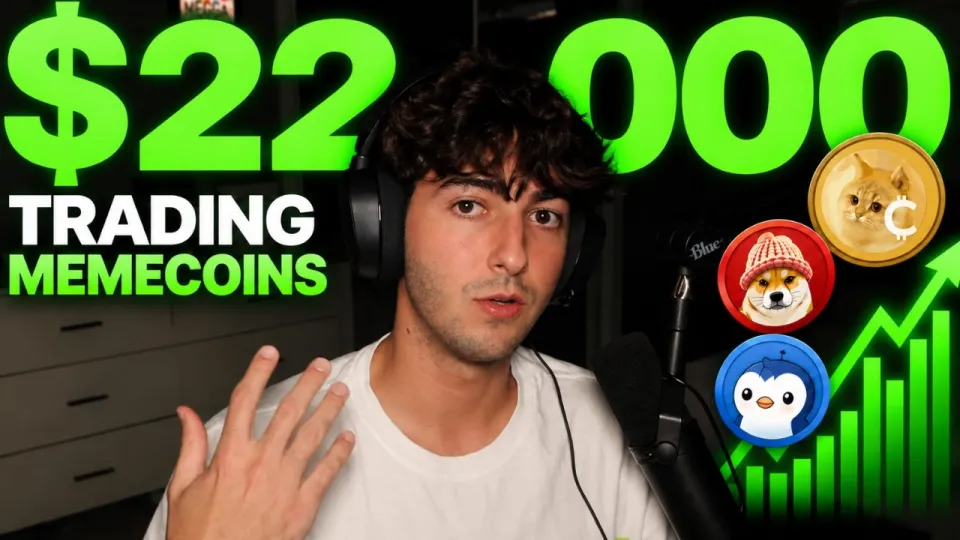
Meme Coin Trading, Anatomy of a $22,000 Single Trade
Need articles like this for your video? They help promote it on YouTube and Google — order them in the Telegram bot @sat_sit_bot. Articles with your video embedded are written and posted by the bot itself — on popular topical sites (no ads). Free trial — 50 articles.
· based on the channel Megga
A meme coin trade is a short-lived bet on liquidity and attention, not on fundamentals: the trader buys a low-cap token early, sells into the first wave of buyers and accepts that the position can go to zero. Megga's breakdown of a single meme coin trade that returned $22,000 shows the mechanics behind that bet — entry, sizing, scaling out and a hard exit — and the free beginner material for the same process is available at the Wired beginner guide on Whop.
What a meme coin trade actually is
A meme coin trade is a position held for minutes to days in a token with no cash flow, where price is set entirely by the order book and by how fast new buyers arrive. That single fact drives everything else: there is no earnings report to wait for, no valuation floor, and the only exit is the buyer behind you.
Three properties separate meme coins from large-cap crypto:
- Liquidity is thin and removable. A pool can hold a few hundred thousand dollars, and the person who created it can pull it. Slippage on the way out is often worse than on the way in.
- Supply is concentrated. A handful of wallets frequently holds a large share of the float, so a single seller can move the price more than any chart pattern.
- Attention decays fast. A token's lifespan is tied to a narrative — a mascot, a tweet, a community joke — and that narrative loses force within days, sometimes hours.
Megga's $22,000 result came from one such position, which means the useful lesson is not the token but the process around it: how much was risked, when profit was taken, and what forced the exit.
The trade structure behind a five-figure result
A five-figure meme coin result usually comes from a small number of decisions executed without hesitation, and the walkthrough format makes those decisions visible. The sequence below is the standard structure such trades follow.
- Entry before the crowd. The position is opened while liquidity is still small and the chart is quiet. Buying after a token is already trending on social feeds means paying the markup the early buyers created.
- Sizing that survives a total loss. Meme coin positions are sized so that a 100% loss is an acceptable cost, not a portfolio event. A trade that can return $22,000 can also return zero.
- Scaling out, not exiting at once. Selling in tranches — part on the first strong push, part on continuation — locks in profit while keeping exposure to a further leg up.
- A pre-set invalidation. The exit is decided before entry: a market-cap level, a loss of momentum or a visible cluster of large sell orders.
What separates this from gambling is that the loss is defined in advance. The $22,000 figure is the outcome of one path; the same setup with a slightly later exit or a thinner pool produces a very different number.
Where the $22,000 came from
Profit in a meme coin trade is the difference between the average entry and the average exit, multiplied by size, minus fees and slippage — and in small pools, slippage is the largest hidden cost. A position that looks like a 10x on the chart can settle at 6x once the sell orders are walked through a shallow book.
Practical consequences for anyone trying to repeat the result:
- Check pool depth before sizing. If the trade is large relative to the liquidity pool, the exit moves the price against you.
- Count fees twice. Network fees, swap fees and priority fees apply on both sides, and priority fees rise exactly when everyone is trying to exit.
- Assume the exit is slower than the entry. Sellers compete for the same buyers, and the first large seller usually gets the best fill.
Megga's terminal of choice is linked in the video description through the Padre trading terminal, which is where the execution side of such trades happens.
Risks the highlight reel leaves out
A single profitable meme coin trade is one sample, and the risks that make the sample possible are the same ones that make most attempts fail. Anyone treating a five-figure screenshot as a base case is reading the distribution backwards.
- Rug pulls and insider supply. Tokens can be drained by their creators, and wallets connected to the launch often hold supply that hits the market at the first sign of demand.
- Coordinated groups. When a trader has a large audience or a circle of peers, part of the demand is friendly flow. A trader without that circle faces a thinner book and slower fills on the same setup.
- Survivorship in content. Videos are made about the trades that worked; the ones that went to zero rarely get a breakdown.
- Slippage on size. The strategy that returns $22,000 on one size can be unexecutable at ten times that size, because the pool cannot absorb the order.
A realistic approach treats meme coin trades as a series of small, capped bets where a few winners pay for many losers — not as a repeatable income stream.
Questions traders ask before copying a trade
The most common doubts around meme coin content are about replicability, and they are fair: the conditions in a video are rarely the conditions a viewer faces. Three practical checks help before copying any trade.
- Is the entry still available? By the time a video is published, the token's market cap has usually moved far past the entry point.
- Can you get out at the same price? Compare your position size to the pool depth; if your exit is a meaningful share of the liquidity, your result will differ.
- Are you trading the same book? A trader with a large following generates demand that a solo trader does not, which changes both the upside and the exit.
Smaller account challenges — starting with a modest bankroll and aiming for a defined target — are a more honest test of a process than copying a single large win, because they force position sizing and exit discipline to carry the result.
All links from the breakdown
All resources referenced in the video, in one place:
- Free beginner guide: https://whop.com/wiredd
- Trading terminal: https://trade.padre.gg/rk/megga
- Twitch: http://www.twitch.tv/megga
- TikTok: https://www.tiktok.com/@meggafaze
- Twitter: https://twitter.com/megga
Final takeaway
A $22,000 meme coin trade is a case study in execution, not a promise: entry before attention, sizing that survives a zero, staged exits and a pre-defined invalidation. The number is real for the trader who took it, but it depends on liquidity, timing and a book that a viewer will not reproduce exactly. Treat the breakdown as a template for process and risk, and treat the profit figure as one outcome among many. Megga's channel is where the full walkthrough lives, and the free beginner guide on Whop is the starting point for the mechanics before any capital is committed.
Key takeaways
- Megga reports a $22,000 profit from a single meme coin trade, broken down as a full walkthrough on the channel.
- The trade structure is entry, scaling out into momentum and a hard exit before liquidity thins.
- Free beginner material is hosted at whop.com/wiredd, and the trading terminal used is linked through trade.padre.gg.
- Meme coin outcomes depend on liquidity depth, holder concentration and exit speed more than on chart patterns.
- Copying a trader with a large audience changes the trade itself: fills, slippage and exit liquidity are not the same.
Source: How I Made $22,000 in a SINGLE Memecoin Trade (FULL GUIDE) · Markdown version
Questions & answers
Can a beginner realistically make $22,000 from one meme coin trade?
It is possible but statistically rare. A five-figure result requires an early entry, a position size large enough to matter and an exit before liquidity thins. Most attempts end at a loss, so the realistic goal for a beginner is to learn sizing and exits on small amounts first.
How much should I risk on a single meme coin position?
Only an amount whose total loss would not change your financial situation, because a 100% loss is a normal outcome. Professional meme coin traders typically cap such positions at a small percentage of their portfolio and treat a series of trades, not one trade, as the unit of results.
Why do results differ between a large trader and a small account?
A trader with a large audience and a circle of peers generates demand that a solo trader does not, which affects fills and exit liquidity. The same setup executed without that flow faces a thinner order book, more slippage and a slower exit.
What is the biggest hidden cost in meme coin trading?
Slippage, especially on the exit. Network fees, swap fees and priority fees also apply on both sides of the trade, and priority fees rise exactly when many traders try to sell at the same time.